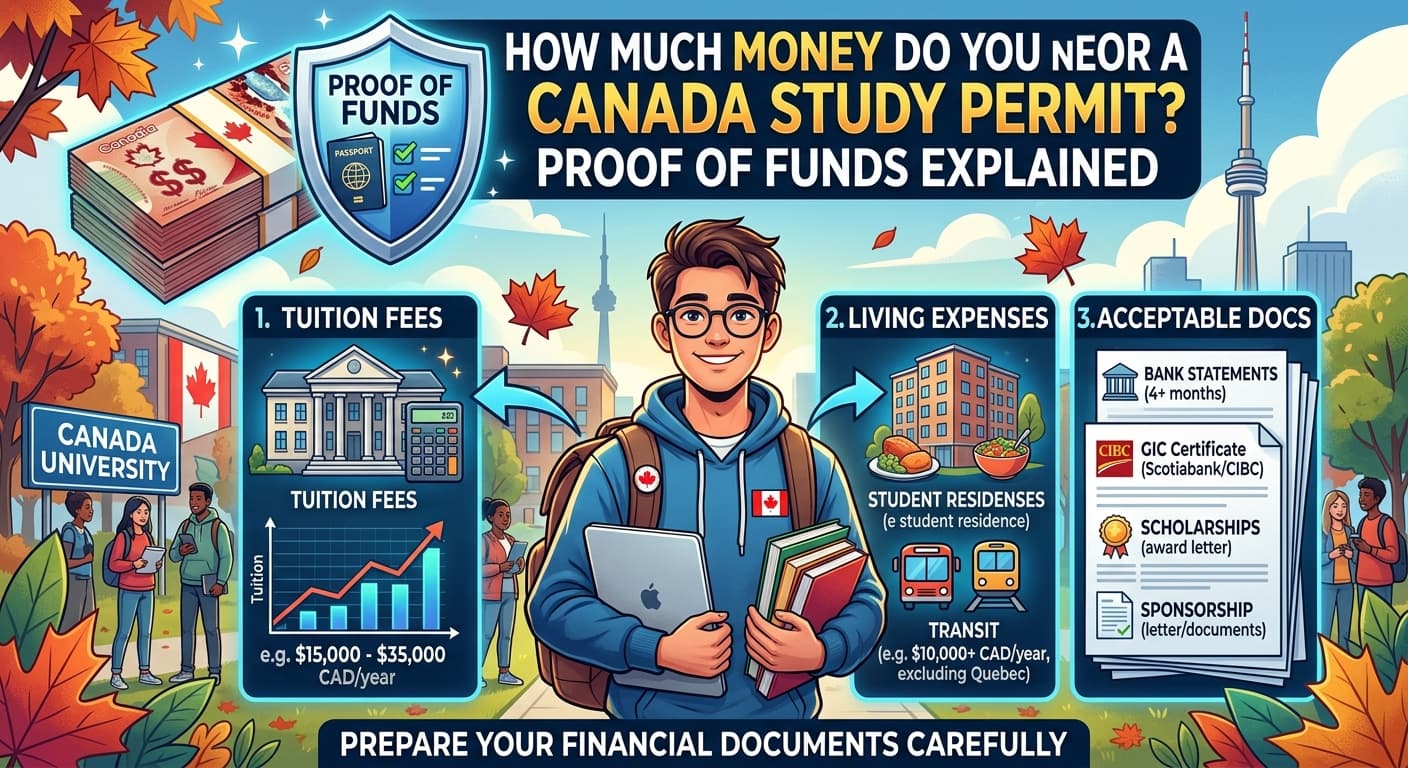
What canada study permit proof of funds actually covers
Most applicants assume proof of funds means one big number sitting in an account. It doesn't. It means a specific, documented, traceable combination of money that covers tuition, living costs, and a ticket home — and the traceable part is where applications fall apart.
The baseline requirement, straight from canada.ca, is that you demonstrate enough money to pay first-year tuition, cover living expenses for yourself (and any family coming with you), and fund return transportation, without needing to work in Canada to survive. That last clause matters more than people give it credit for. Officers aren't just checking you have money. They're checking you won't be desperate for a job in month three.
On top of the money itself, budget for the application mechanics: a standard $150 CAD processing fee, plus an $85 CAD biometrics fee where it applies. Small next to tuition, but it's a separate line item people forget to set aside.
The documents officers actually trust, and the ones they don't
Not all proof is equal. A GIC through a participating Canadian bank is treated almost like cash because it's locked, verified, and sitting in Canada already. A personal bank statement from home needs history behind it. A letter from a relative promising support is close to worthless without their own financial records attached.
Document type | What it proves | Where it usually goes wrong |
|---|---|---|
GIC certificate | Funds held and locked in Canada | Applicant assumes it alone covers everything, ignoring tuition owed separately |
Personal bank statements | Ongoing, stable access to funds | Submitted for one month instead of several; balance jumps right before applying |
Education loan sanction letter | Formal, institutional funding | Loan approved but not yet disbursed, so the money isn't actually accessible |
Sponsor's affidavit and statements | A named third party's capacity to pay | No explanation of the relationship or why that person is funding you |
Property or land valuation certificate | Net worth, not liquidity | Submitted as if it were cash, with nothing showing it can be converted |
If a document doesn't show money an officer can actually trace to an actual account, it isn't proof of funds — it's background information. That distinction is where a lot of otherwise strong applications get stuck.
The sudden deposit problem nobody explains properly
Here's the scenario that trips up more applicants than any tuition shortfall: a relative wires a large sum into your account six weeks before you apply, the balance looks great, and the application still gets flagged.
Officers are trained to notice money that appears out of nowhere. A balance that's been building steadily over four to six months reads as genuine saving or stable income. A balance that jumps from near-zero to the full requirement in a single deposit reads as borrowed money assembled just to clear the bar — even when it isn't.
The fix is a Letter of Explanation, and it needs to do real work, not just assert innocence. A usable LoE states: who sent the money, their relationship to you, the source of their funds (salary, sale of an asset, matured investment), and the date it was transferred, cross-referenced against a bank-issued transfer receipt. Attach the sender's own account history showing the money existed before it moved, not just that it arrived. A one-paragraph letter saying "my uncle gave me this money" with no supporting trail changes nothing; a letter with dates, account numbers, and a matching deposit slip usually does.
If the deposit timing or the explanation looks thin, don't be surprised if the file gets a closer look. That's one of the more common reasons applicants end up facing extra questions, and it's worth reading through what to expect at your Canada study permit interview if that happens, because the questions tend to circle back to exactly this: where did the money come from, and can you prove it.
Gold, provident funds, and property: what actually counts
This is the part most guides skip, and it's the part that affects the biggest share of applicants from India, Nigeria, and the Philippines, where family wealth is often held in assets rather than bank balances.
Real estate equity isn't accepted as proof of funds on its own. A land valuation certificate shows net worth, not liquidity, and officers want to see money that can be spent, not money that's theoretically there if the property sells. The workaround is converting it: a loan taken out against the property, with the loan amount disbursed into a bank account, works. The raw valuation certificate does not.
Gold holdings face the same problem, made worse by the fact that gold doesn't sit in a bank statement. If gold is being sold to fund the degree, you need the sale receipt and the deposit of proceeds into a traceable account, dated with enough runway before the application that it doesn't look like a last-minute scramble.
Provident fund withdrawals (EPF in India is the common case) are generally accepted, but only once the money has actually been withdrawn and deposited, not while it's still sitting in the fund as a notional balance. A fund statement alone proves entitlement, not access.
What exchange rates do to an application nobody budgeted for
Currency volatility is the quiet killer of otherwise solid files. You calculate your required amount in CAD, convert at today's rate, and submit statements in rupees, naira, or pesos that technically clear the bar. Six weeks later the exchange rate moves, your home currency weakens, and the same bank balance converts to less CAD than it did on submission day.
Officers generally work from the rate at the time of assessment, not the day you filed. The safe move is padding your local-currency total by a margin you wouldn't normally bother with, specifically to absorb a currency swing between submission and decision. In countries with capital controls — parts of Nigeria and several South Asian markets — there's an added wrinkle: funds that are legally yours on paper may not be freely transferable abroad, which matters once you're actually paying tuition, not just proving you can.
Sponsors, family members, and the questions people actually ask
A parent sponsoring is the easy case. A friend or distant relative sponsoring is allowed, but it needs more explanation: why this person, what's the relationship, and their own financial documents showing the money is genuinely theirs to give. Thin explanations here are a common reason files get flagged for extra review.
If a spouse or children are coming with you, the living-expense requirement increases per person, on top of your own. The exact figures move over time, so check the current table on canada.ca rather than relying on last year's number, which is exactly the kind of detail people get wrong by copying an old blog post.
And you only need to prove the first year of a multi-year degree, not the whole thing upfront. Renewal applications later will ask the same question again, for the year ahead.
FAQ
How many months of bank statements do I need to submit for a Canada study permit?
Visa offices generally want to see 4 to 6 months of statements showing a stable or growing balance, according to canxglobal.com. A balance that appears two weeks before you apply, with nothing behind it, reads very differently than the same number sitting there for half a year.
Can property or land valuation certificates be used as proof of funds?
Only indirectly. A land valuation certificate shows you own an asset, not that you have cash. Officers want liquidity, so you generally need to convert that equity into a loan, a sale, or a bank-held sum before it counts toward your canada study permit proof of funds.
Do I need to show funds for the entire multi-year degree upfront or only the first year?
Only the first year. The requirement is enough to cover first-year tuition, living expenses, and return transportation. You'll still need to show you can fund later years when you renew your permit, but you don't front-load four years of costs into one application.
Can a friend or distant relative sponsor my Canadian study permit?
It's allowed, but it's a harder case to make than a parent sponsoring. You'll need a clear explanation of the relationship and why that person is funding your education, plus their own financial documents, because officers are checking the money is genuine and not borrowed for the application.
How much additional living expense money is required for accompanying family members?
IRCC requires extra funds per accompanying family member on top of your own living costs and tuition, with the exact figures adjusted periodically. Check the current cost-of-living table on canada.ca before you calculate your total, since it changes more often than people expect.