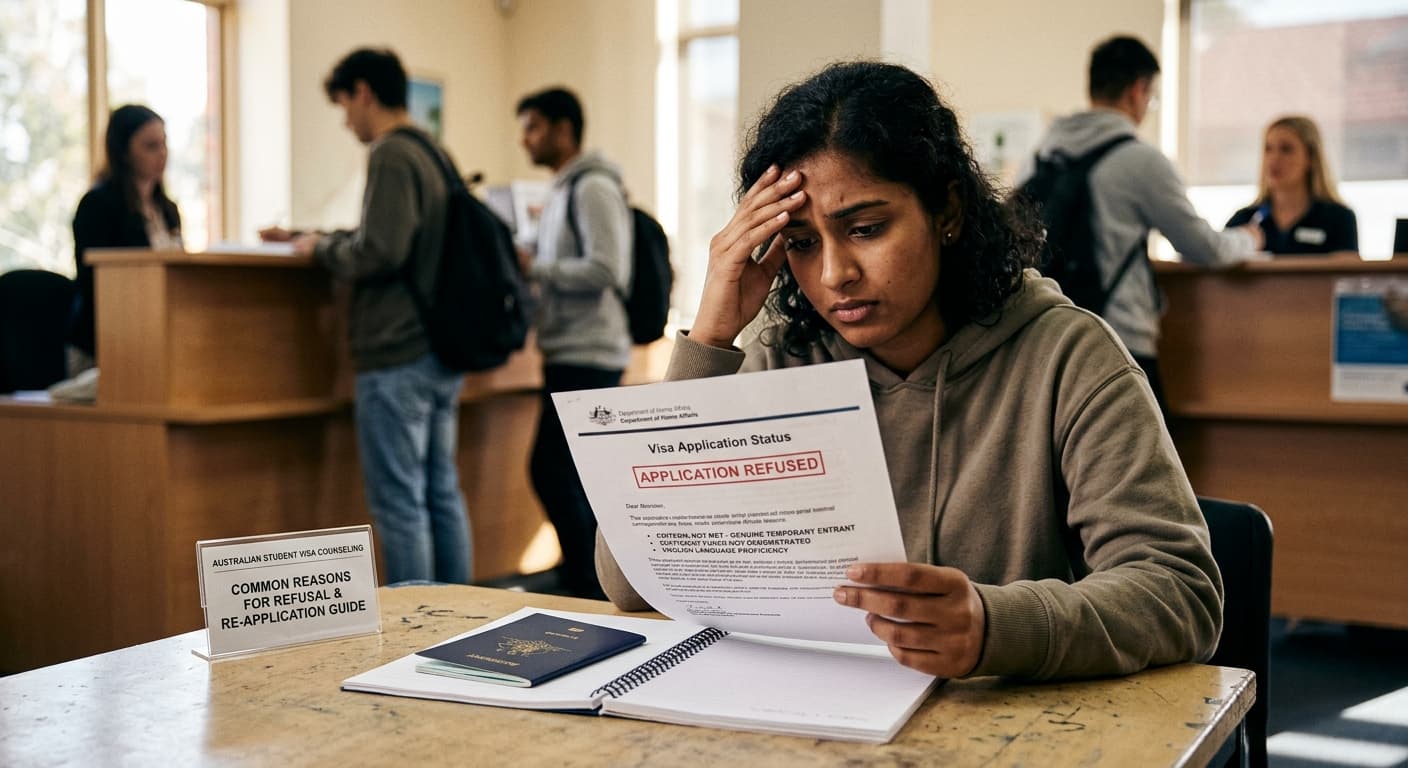
An Australian student visa refused letter is not a dead end, whatever it feels like
Getting that email from the Department of Home Affairs lands hard. Weeks, sometimes months, of paperwork, and then a PDF that opens with "I have decided to refuse." Here's the part worth knowing before you do anything else: an Australian student visa refused outcome is a specific, documented reason, not a verdict on you as a person. The letter tells you exactly what clause you failed. That's your starting point for whatever comes next.
Most people read the letter once, panic, and either give up or resubmit the same application with a nicer cover note. Neither works. The refusal letter is a diagnosis. Treat it like one.
The reasons an Australian student visa gets refused, in order of how often they actually happen
Australian student visas fall under the Subclass 500 framework, and refusals cluster around a small number of causes, according to acmglobal.com.au. Knowing which one applies to you changes the entire reapplication strategy.
Genuine Student (GS) criteria failure — the case officer wasn't convinced you intend to study and then leave, or that study is your real purpose for coming to Australia.
Financial capacity doubts — your bank statements don't match the cost of the course, or the source of the funds looks unclear or recently inflated.
PIC 4020 integrity breaches — false or misleading information or documents somewhere in the application, even in a section you thought was minor.
Health or character issues — rare for students, but they happen, usually tied to police checks or medical examination results.
Incomplete or inconsistent documentation — gaps between your CoE, your financial declaration, and your statement of purpose.
The GS criteria replaced the old Genuine Temporary Entrant requirement in 2024, but the underlying question is the same one it always was: does your story hold together. A genuine temporary entrant requirement assessment under the old rules and a GS assessment under the new ones are both, at bottom, a test of coherence. If your study plan, your finances, and your migration history don't tell one consistent story, that's where refusals come from.
PIC 4020 is the one that changes everything
This is worth separating out because it is not like the others. A GS refusal means your case wasn't strong enough. A PIC 4020 finding means the department believes you submitted false or misleading information, and it can trigger an exclusion period of several years before you can apply for most Australian visas again, as outlined by acmglobal.com.au. That's not a reapply-next-week situation. If your refusal letter mentions PIC 4020, read it twice and get advice before you touch another application form.
What a Section 48 bar actually stops you doing (and what it doesn't)
If you're onshore when the refusal lands, you'll likely run into Section 48 of the Migration Act. It's barely mentioned on most advice pages, and it's the single thing that trips people up the hardest.
Section 48 blocks most onshore visa applications once you've had a visa refused or cancelled while in Australia. You can't simply pivot to a different subclass and file from your share house in Melbourne. There are exceptions — certain partner visas, protection visas, and a handful of others — but a second student visa application generally isn't one of them while you remain onshore.
What this means practically: once an Australian student visa refused decision has a Section 48 bar attached, your realistic onshore options are the ART appeal or leaving the country. Reapplying from within Australia, for most people in this position, is not legally available at all. That single fact decides more reapplication strategies than anything in the refusal letter itself.
Appeal through the ART, or withdraw and reapply from offshore?
This is the decision nobody frames clearly enough, and it's the one that actually matters once you understand your case.
Factor | ART Appeal (onshore) | Reapply offshore |
|---|---|---|
Cost | AU$3,580 fee, per educationone.net.au, plus legal costs | New visa application fee, usually cheaper overall |
Timeframe | Can run well over a year; some matters take multiple years | Standard processing once a strong new application is lodged |
Bridging visa status | A bridging visa generally lets you stay in Australia while the review is pending | None — you need to depart first |
Best suited to | Cases where the refusal looks like officer error or missing evidence | Cases with a genuine gap in finances, documents, or GS evidence |
If your Australian student visa refused decision came down to a documentation mix-up, something a case officer misread or a bank letter that didn't translate cleanly, the ART appeal can be worth the wait and the AU$3,580. If the refusal exposed a real weakness in your case, more time and money spent defending the same application usually just delays the same outcome. Withdrawing, fixing the gap, and reapplying offshore is often faster and considerably less expensive than people assume going in.
Will your education provider even give you a new CoE?
Nobody talks about this enough. Your Confirmation of Enrolment doesn't survive a refusal automatically — most providers cancel or pause it the moment the visa is refused, and reissuing a new one is a business decision, not a formality.
Providers look at why you were refused before agreeing to a fresh CoE. A financial capacity issue that you've since resolved is usually fine. A PIC 4020 integrity finding makes some institutions nervous enough to decline outright, because the provider's own visa compliance record with the department is tied to the students it enrols. Call your institution's international office directly, ask what their policy is on reissuing a CoE after refusal, and get it in writing before you spend money on a new application.
Rebuilding the GTE statement for student visa approval
Under the current GS criteria, your personal statement is still doing the same job a GTE statement always did: proving your study plan is real, sequential, and connected to your life back home. The common mistake in a reapplication is tweaking the wording instead of fixing the substance.
A strong statement after a refusal does three things. It names the specific reason you were refused and addresses it directly, rather than hoping the officer won't notice it happened before. It adds new, dated evidence rather than reusing the same bank statement with a new cover letter. And it explains, plainly, why this course at this provider is the logical next step from what you've already studied or worked in — not just an available seat.
A reapplication that doesn't name and fix the original refusal reason reads, to a case officer, exactly like the one they already refused.
Why most people shouldn't do this alone the second time
A first-time student visa application has some margin for error. A reapplication after a refusal has almost none, because the case officer reviewing it can usually see the refusal history attached to your file. That's the point at which getting qualified help stops being optional for most applicants. If you're weighing up whether to handle a reapplication yourself or bring in someone registered with the department, it's worth reading through 5 Reasons to Hire a Visa Consultant Instead of Doing a DIY Application before you start drafting anything new. The cost of a consultant is small next to the AU$3,580 ART fee, let alone a second refusal and a longer exclusion period.
Here's the uncomfortable bit nobody likes admitting: the common advice to "just explain yourself better" in a second attempt is usually wrong. Officers aren't looking for better prose. They're looking for a changed set of facts.
FAQ: the questions people actually ask after a refusal
Can I reapply for an Australian student visa immediately after a refusal?
Offshore applicants can usually lodge a fresh application straight away, provided they've addressed the reason for the original refusal. Onshore applicants often run into a Section 48 bar, which stops most new visa applications from inside Australia until you leave, unless a narrow exception applies.
How much does it cost to appeal a student visa refusal at the ART?
The standard fee to lodge a review with the Administrative Review Tribunal is AU$3,580 as of July 2025, per educationone.net.au. That figure sits on top of whatever you already spent on the original application and any legal help you bring in for the review itself.
How long do I have to appeal an Australian student visa rejection?
Onshore applicants typically have 21 days from receiving the refusal notification to lodge an appeal with the ART, according to educationone.net.au. There's no extension for missing that window through disorganisation, so get advice the day the letter arrives, not the week after.
Does an Australian student visa refusal affect visa applications to Canada, the UK, or the US?
It doesn't block you automatically, but almost every visa form for those countries asks whether you've ever been refused a visa anywhere. Disclosing it honestly with an explanation is a far smaller risk than being caught concealing it later.
What happens to my tuition deposit and CoE if my student visa is refused?
Your CoE is typically cancelled or put on hold once the refusal takes effect, and most providers won't refund the deposit automatically. Deferral and refund policies differ by institution, so contact the provider's international office directly before deciding whether to appeal or reapply.
None of this makes an Australian student visa refused letter pleasant to open. It does make it a lot less random than it feels on the first read, and that's really the whole game: figure out which specific thing went wrong, decide honestly whether appeal or reapplication fits your facts, and stop treating the second attempt like a rewrite of the first.