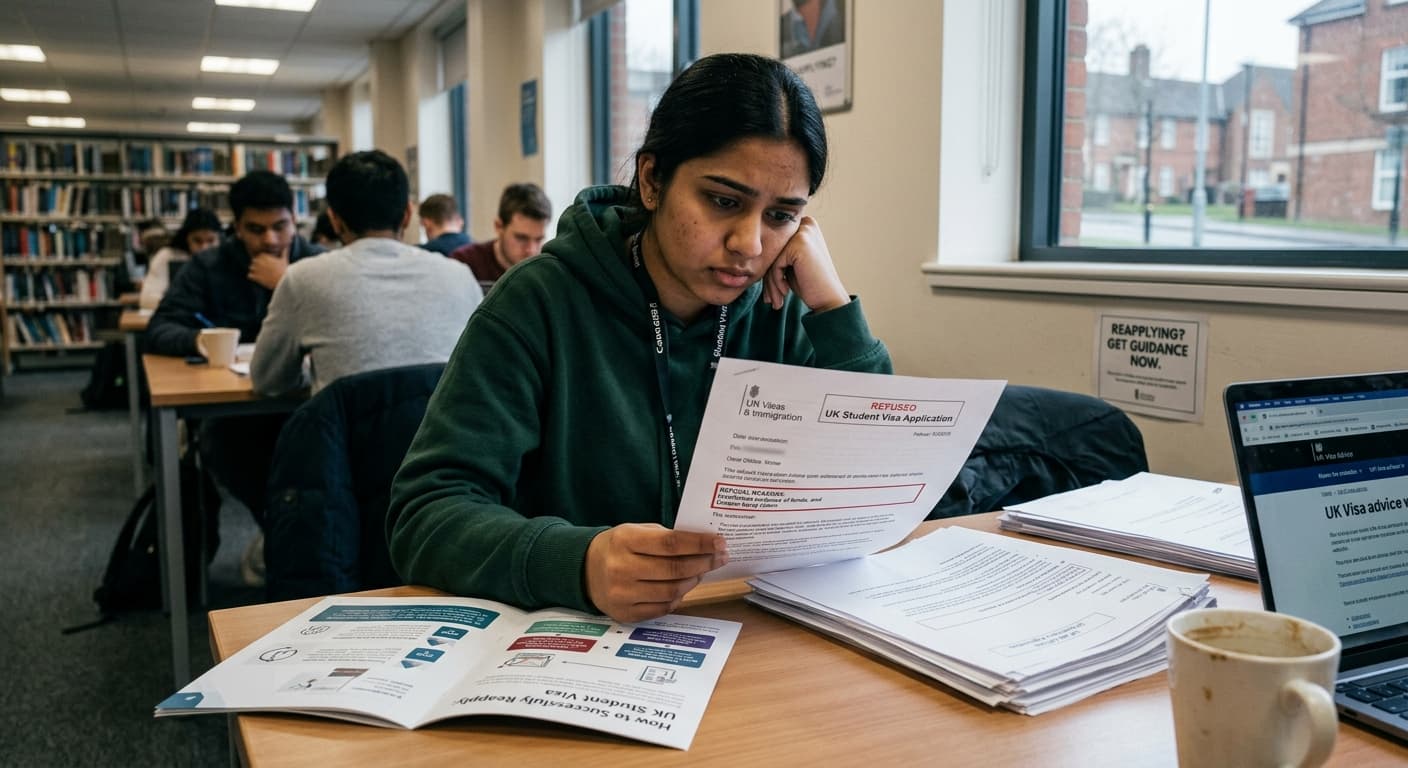
Your UK student visa refused letter isn't the end of the story
Getting a UK student visa refused feels final. It reads final. There's a reference number, a list of reasons in Home Office language, and a clear sense that a door just closed. It hasn't. Most refusals are fixable, and a lot of the people who get refused made the same three or four mistakes that show up on refusal letters every week.
The problem is that most guidance on this treats every refusal the same way, when the right response depends entirely on what the letter actually says. A refusal over a bank statement that was seven days short of the holding period is a completely different problem from a refusal that questions whether you're a genuine student. Treating them the same is how people waste £80 on an Administrative Review that was never going to work.
What actually causes a UK student visa refused decision
Financial evidence is the single biggest cause, and it's almost always avoidable. The rule is specific: your funds need to sit in the account, untouched, for 28 consecutive days, and that 28-day window has to end no more than 31 days before you submit the application, according to Garth Coates (garthcoates.com). Miss that by two days and the whole application gets refused, regardless of how much money is actually in there.
The second big category is the genuine student requirement. UKVI doesn't just check your documents, it checks whether your study plan makes sense. If you're applying for a course that doesn't obviously follow from your previous qualifications, or your interview answers about why you chose this university sound rehearsed and thin, that gets flagged. Caseworkers have seen thousands of these applications, and vague answers stand out immediately.
Then there's the boring stuff that still sinks applications: a missing TB test certificate for applicants from listed countries, an academic transcript that doesn't match what the CAS states, a passport scan that's slightly cut off. None of these are complicated. All of them are common. A UK student visa refused on a technicality like this is genuinely one of the most frustrating outcomes, because the fix was always available and nobody caught it before submission.
Administrative Review, reapplication, or Judicial Review — which one is yours?
This is where most advice gets vague, and vague advice here costs you time you probably don't have if term starts in six weeks.
Administrative Review only works for casework errors: the Home Office misapplied its own rules, missed a document you actually submitted, or made a factual mistake reading your evidence. It costs £80, according to Garth Coates (garthcoates.com), and it has to be lodged within 14 calendar days of an in-country refusal, or 28 calendar days for a refusal of entry clearance from overseas. Miss that window and the option disappears.
If the refusal was correct on the facts, meaning your bank balance genuinely dipped below the threshold, or a document genuinely was missing, Administrative Review won't help. You didn't get refused by mistake. You got refused correctly, for something you can now fix. That's a reapplication, not a review.
Judicial Review sits above both of these and is for a narrow set of cases: where the decision itself was unlawful, irrational, or procedurally unfair, not just wrong on the merits. It's slower, more expensive, and generally not the right tool unless a solicitor has actually looked at your case and told you it applies.
The timing trap nobody warns you about
Here's the part that decision trees online skip entirely: Administrative Review has no published turnaround time. Some resolve in a few weeks. Others take considerably longer. If your course starts in eight weeks and you're staring down an open-ended review queue, ask yourself honestly whether you can afford to wait it out, because a successful review that lands after enrolment closes has solved the wrong problem.
A rough way to think about it: if the fix is factual and quick (a document error, a maths mistake in the funds calculation) and your start date is comfortably far off, Administrative Review is worth the £80. If the clock is tight, or the refusal touches the genuine student requirement, reapplying with stronger evidence is usually faster and safer than waiting on a review that might not even go your way.
Route | Cost | Deadline | Best for |
|---|---|---|---|
Administrative Review | £80 | 14 days in-country / 28 days overseas | Genuine casework or factual errors |
Reapplication | Full visa fee + new CAS | No fixed deadline | Refusals that were factually correct but fixable |
Judicial Review | Court fees, higher | Strict, short, seek legal advice | Unlawful or irrational decisions |
Get the caseworker's actual reasoning before you reapply
Almost nobody does this, and it's arguably the most useful step available to anyone whose UK student visa refused case is genuinely confusing. The refusal letter gives you a summary. It doesn't give you the caseworker's full notes, or the interview transcript if you had a credibility interview. You can request both under a Subject Access Request.
A Subject Access Request asks the Home Office for the personal data it holds on you, which in practice includes caseworker annotations and interview records. Submit it in writing, reference your Home Office ID or GWF number, and be specific about what you want: the interview transcript, and the caseworker's internal notes on your application. It won't come back overnight, but it often surfaces exactly which sentence in your interview or which line in your bank statement triggered the refusal. Guessing at that from the refusal letter alone is much harder than reading the actual reasoning.
Writing an explanatory statement that doesn't dig you deeper in
If you're reapplying after a genuine student or credibility refusal, you'll often want to include a short explanatory statement addressing the previous decision. This is where a lot of reapplications go wrong, because people either ignore the refusal entirely, which looks evasive, or over-explain in a way that contradicts what they said the first time.
The safer approach: acknowledge the specific point raised, address it with new or clarified evidence, and stop. If your interview answer about career plans sounded thin, don't now claim a completely different long-term goal, that reads as coached. Instead, expand on the same plan with more concrete detail: named modules, a specific industry you're targeting, why this university's course structure actually serves that goal better than alternatives at home. Consistency with your original story, backed by better evidence, beats a rewritten story every time.
Do you need a new CAS if your UK student visa is rejected?
Yes, and this trips people up constantly. A previous CAS cannot be reused after a visa refusal; your sponsoring university has to issue a brand new CAS before you submit another application, according to the University of Manchester (manchester.ac.uk). Contact the admissions or international student office the same week you decide to reapply, not after you've rebuilt the rest of your evidence, because CAS reissue can add its own delay to an already tight timeline.
Building the reapplication so it actually holds up
Fix the specific thing that got flagged, not the whole application from scratch. If it was financial evidence, recheck the 28-day holding period against the exact date you plan to submit, and get a bank letter that states the balance clearly rather than relying on a printed statement alone. If it was documentation, build a checklist against the CAS requirements line by line, including the TB certificate if your country requires one and the transcripts matching exactly what the CAS states.
If English language requirements are part of what's unclear in your case, it's worth checking whether you actually needed IELTS at all, since certain nationalities and qualifications carry exemptions that some applicants miss entirely, leading them to submit weaker evidence than they needed to.
A refusal that gets properly diagnosed before reapplying has a much better chance than one that's just resubmitted with the same file and a hopeful cover note.
This is also the point where a lot of applicants decide to bring in professional help rather than go it alone a second time. There's a reasonable case for that: someone who reads refusal letters for a living will spot the actual failure point faster than you will on your third read-through at midnight. If you're weighing that up, it's worth looking at the specific reasons a visa consultant tends to outperform a DIY reapplication, particularly around exactly this kind of second-attempt case.
It's also worth knowing the base rate isn't as grim as refusal letters make it feel. Overall approval rates for UK study visas are considerably higher than the volume of refusal horror stories online would suggest, and the actual success ratio for UK student visa applications is worth reading before you assume a second attempt is a long shot.
The part that actually decides whether the reapplication works
It isn't the strength of your explanatory statement, and it isn't luck. It's whether you correctly identified what actually caused the UK student visa refused decision in the first place. Get that diagnosis wrong, and you can spend weeks perfecting a bank statement while the real issue was your interview answers all along.
So before anything else, read the refusal letter twice, request the caseworker notes if the reasoning still isn't clear, and only then start rebuilding. The applicants who reapply successfully are rarely the ones who worked hardest. They're the ones who worked on the right thing.
FAQ: UK student visa refused, reapplication and appeals
Can I reapply for a UK student visa immediately after a refusal?
Yes, there's no mandatory waiting period before you submit a fresh application. What matters is that you have a new CAS from your university and a real fix for whatever caused the refusal, since reapplying with the same weak evidence just produces a second refusal.
How long does an Administrative Review take for a UK student visa?
UKVI doesn't publish a fixed turnaround, and it varies with caseload, but waits of several weeks to a couple of months are commonly reported. If your course start date is close, that uncertainty alone is a good reason to consider reapplying instead of waiting it out.
Will a student visa refusal affect my future UK visa applications?
A refusal isn't an automatic bar to future visas, but it stays visible to caseworkers and gets read alongside your new application. If the original refusal cited dishonesty or a genuine student concern, expect closer scrutiny next time, so your reapplication needs to address that point directly rather than hoping it gets overlooked.
Do I need a new CAS if my UK student visa is rejected?
Yes. A previous CAS cannot be reused after a refusal; your university must issue a brand new one before you submit another application, according to the University of Manchester (manchester.ac.uk). Contact your admissions office as soon as you decide to reapply, since reissue can take time.
What is the cost of requesting an Administrative Review for a UK student visa?
The standard fee is £80, according to Garth Coates (garthcoates.com). It's non-refundable whether the review succeeds or not, which is worth factoring in before you choose Administrative Review over a straightforward reapplication.